Investing
Why index funds win over time (and when they don't)
Low costs and broad diversification make index funds hard to beat over decades. Here is the math behind that, and the situations where they fall short.

By Jordan Hale
2 min read
Updated
An index fund does one boring thing: it buys every company in a market index and holds them. No star manager, no clever timing. That boring design is exactly why it works for most people saving for the long run.
What an index fund is
An index is a list of companies chosen by a fixed rule, such as the five hundred largest in a country. An index fund owns all of them in the same proportions as the list. When the market rises, you rise with it. When it falls, so do you, but you never fall further because one manager made a bad bet.
The quiet power of low fees
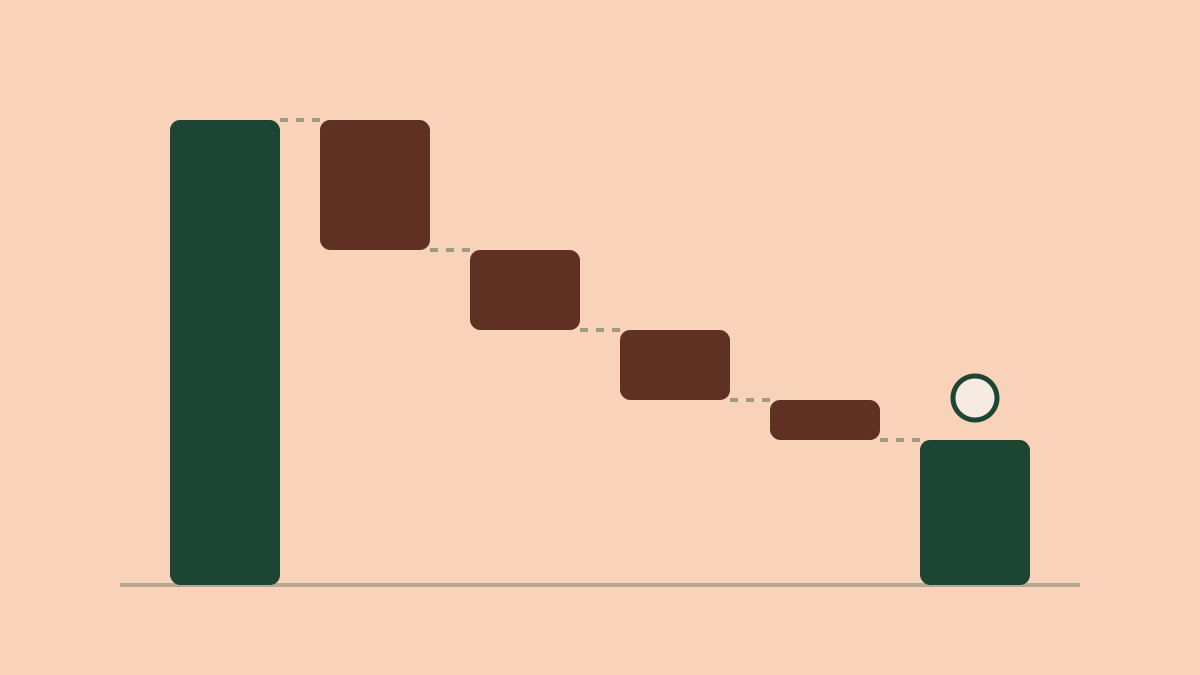
Fees look tiny on paper because they are quoted as a yearly percentage. Over decades they compound in the wrong direction. Take $10,000 left alone for 30 years.
- At a 7% yearly return, it grows to about $76,100.
- At 6%, the same return minus a 1% yearly fee, it grows to about $57,400.
- That single percentage point costs roughly $18,700, or about a quarter of the outcome.
Diversification you do not have to think about
Owning hundreds of companies means no single collapse can sink you. You give up the chance of owning only the next big winner, and in exchange you remove the risk of owning only the next big loser.
When index funds fall short
Short time horizons
If you need the money within a few years, a stock index fund can be down at exactly the wrong moment. Money for a house deposit next year belongs somewhere steadier.
Concentration inside the index
Many popular indexes weight companies by size, so a handful of giants can make up a large share. Broad does not always mean evenly spread, so it is worth looking at the top holdings.
Your own behaviour
The biggest risk is selling in a panic. An index fund only delivers the market's return to the people who stay invested through the bad years.
The takeaway
For most long-term savers, a low-cost, broad index fund held for decades is a sensible core. Keep costs low, keep contributions steady, and keep your hands off the sell button.